
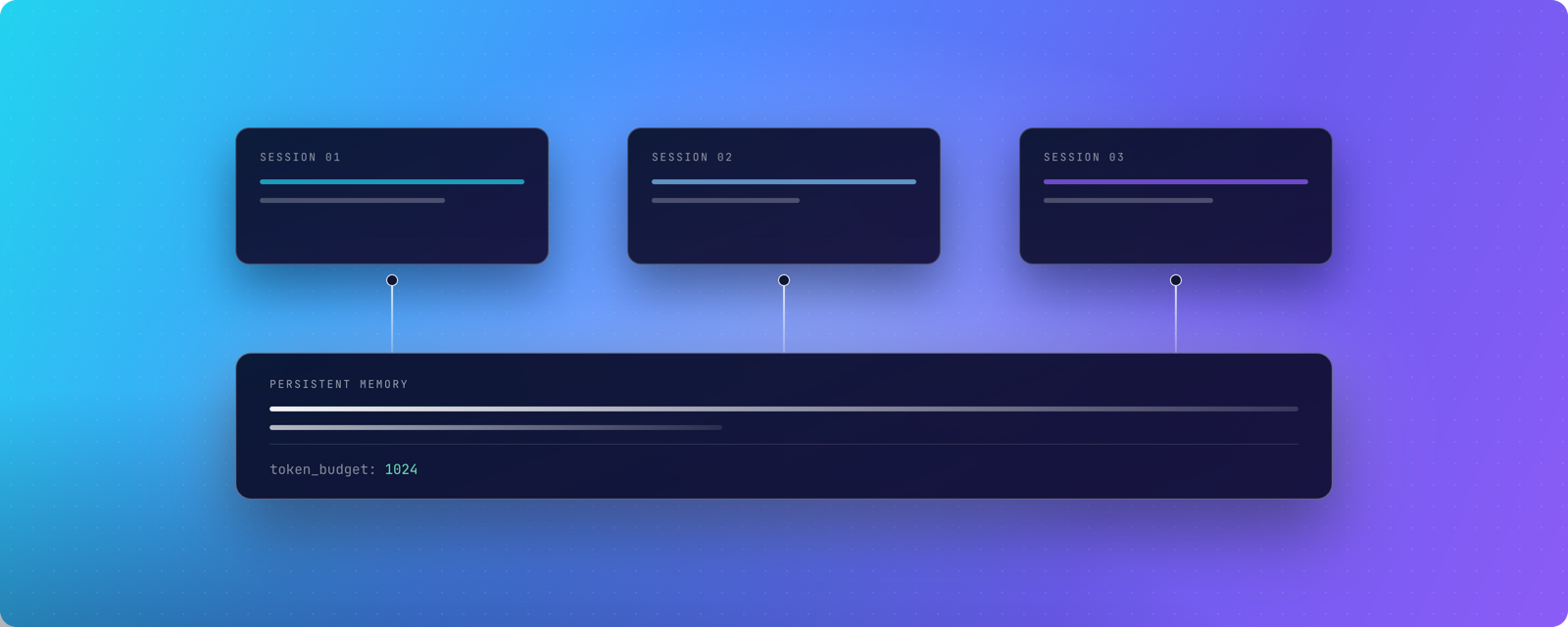
Support is the workload where missing memory hurts most. A customer who told you yesterday that their pipeline runs on Snowflake shouldn't have to say it again today. A subscription user shouldn't have to re-explain their plan tier to every new agent.
The agent shouldn't be guessing — it should be able to cite where it learned each fact.
This post walks through giving a support agent persistent customer memory with Statewave. It's about 30 minutes of work end-to-end, and the result is an agent that remembers across sessions with the same audit trail a human support engineer would leave.
The four steps
The mental model is the same one the getting-started guide covers, with a support-specific shape on each step:
- Record every customer turn as an episode, scoped to a stable customer ID
- Compile episodes into typed memories — profile facts, preferences, procedures, prior-issue summaries
- Retrieve a token-bounded context bundle at the top of each new conversation
- Splice the bundle into the system prompt and let the LLM respond
Each step is a single HTTP call. The agent does no memory bookkeeping itself.
Step 1 — Record
Every customer turn becomes an immutable episode tied to the customer subject. The subject ID should be stable across sessions — your CRM ID, account UUID, or email hash. Avoid using the chat session ID; that's per-conversation, and you want memory to outlive the conversation.
POST /v1/episodes
{
  "subject_id": "cust_4f1a",
  "kind": "chat.message",
  "payload": {
    "role": "user",
    "content": "Our pipeline runs on Snowflake — we hit a connection timeout this morning around 9am UTC."
  },
  "metadata": {
    "channel": "intercom",
    "conversation_id": "intercom_8821"
  }
}
Record both sides of the conversation. Record tool calls the agent made. Record any decisions the human escalation team takes, if a human is in the loop. Everything goes in append-only — Statewave never edits an episode after it's stored.
Step 2 — Compile
After each new batch of episodes, kick off a compile pass for the subject:
POST /v1/memories/compile
{ "subject_id": "cust_4f1a" }
The compiler walks the new episodes and produces typed memories: that Snowflake mention becomes a profile.tech_stack fact with confidence and validity. The 9am UTC timeout becomes a decision.prior_issue memory linked back to the source episode. The next time the user asks "did anyone look at our pipeline?", that prior-issue memory is what surfaces — not a vector-nearest chunk of the original message.
Compilation is idempotent. Running it twice on the same episodes produces no duplicates. You can run it after every turn (low-latency, more API calls) or batch it on a timer (cheaper, slightly staler context). Both modes are supported.
Step 3 — Retrieve
When the user starts a new conversation, fetch a context bundle before calling the LLM:
POST /v1/context
{
  "subject_id": "cust_4f1a",
  "query": "I'm seeing the same timeout again",
  "token_budget": 1024
}
You get back a ranked list of memories and episodes within the budget. Each item carries its provenance — source_episode_ids for memories, the episode itself for raw events. The ranking is deterministic: priority by kind (procedures beat casual mentions), recency-weighted, validity-filtered, similarity for tie-breaks.
Step 4 — Splice
Drop the bundle into the system prompt. We recommend a section header so the model knows what it's looking at:
You are a support engineer for Acme. Use the following durable memory
about this customer when relevant:

[MEMORY START]
- Tech stack: Snowflake (confidence 0.91, observed 2026-04-12)
- Prior issue (2026-04-14): pipeline connection timeout around 9am UTC.
  Resolved by raising the connect_timeout setting in the Snowflake
  connector. Source: episode ep_7a2…
- Communication preference: terse, no marketing language. Source: ep_6b9…
[MEMORY END]

Cite the source episode IDs above when you reference a remembered fact.
That
Cite the source episode IDsinstruction is what turns the agent from "AI that confidently makes things up" into one that points at receipts.
What the benchmark measures
The support workflow benchmark in statewave-memory-benchmarks scores an agent on eight criteria that map to real support concerns:
- Identity facts persist across sessions
- Preferences surface for matching tasks
- Token budgets are always respected
- Provenance traces back to source episodes
- Compilation is idempotent — no duplicates
- Session-aware ranking boosts active sessions
- Repeat-issue detection surfaces prior fixes
- Health scoring is deterministic and explainable
Those eight are the transferable part. Run them against your own stack before you run them against ours — they are the eight questions worth asking of any memory layer, and the harness is open source, so the scoring is inspectable rather than asserted.
What this doesn't solve
A few things the memory layer deliberately doesn't do:
- It doesn't replace your knowledge base. Product docs, runbooks, troubleshooting articles still belong in your RAG stack. Statewave handles the who you're talking to layer, not the what does the documentation say layer.
- It doesn't make personally identifying information safe by itself. Storage encryption, access control, retention policies, GDPR / CCPA flows are your platform's job. Statewave gives you the substrate; the policy is yours.
- It doesn't ship a routing engine. Statewave returns ranked context. Deciding whether to escalate, hand off to a human, or close the ticket is your application logic.
What it does ship is a memory layer that doesn't forget, with an audit trail you can show to a human reviewer or a compliance auditor. For a support agent, that's the difference between a demo and a deployment.
FAQ
1. How long does it take to add persistent memory to a support agent?
About 30 minutes end-to-end: four HTTP calls — record, compile, retrieve, splice — with no memory bookkeeping in the agent itself.
2. What should I use as the subject ID for a customer?
A stable identifier that survives across sessions — a CRM ID, account UUID, or email hash. Avoid the chat session ID; that's per-conversation, and memory needs to outlive the conversation.
3. How does compilation avoid creating duplicate memories?
Compilation is idempotent — running it twice on the same episodes produces no duplicates. That means you can compile after every turn for low latency, or batch it on a timer for lower cost, without worrying about side effects either way.
4. How much better is this than just concatenating recent chat history?
Score it on a task rather than on recall. The support workflow benchmark scores an agent on eight criteria that map to real support concerns — identity persistence across sessions, preference surfacing, token budget compliance, provenance tracing, idempotent compilation, session-aware ranking, repeat-issue detection, and explainable health scoring. The harness is open source, so run it against your own stack and read the criteria rather than anyone's score.
5. Does the memory layer replace a knowledge base or RAG stack?
No. Product docs, runbooks, and troubleshooting articles still belong in your RAG stack. Statewave handles the who-you're-talking-to layer, not the what-does-the-documentation-say layer.
6. Why instruct the model to cite source episode IDs?
That one instruction is what turns the agent from "AI that confidently makes things up" into one that points at receipts — a reviewer can check the cited episode instead of trusting the claim on faith.
Stay in the loop
Get new Statewave posts by email.
Along with occasional Statewave updates. Unsubscribe anytime — privacy.