
Two questions a regulator, a security reviewer, or a senior engineer will ask about an AI agent in production:
- Where did the agent learn that?
- Can you prove it didn't make it up?
Most LLM applications can't answer either. The model "knew" it. There's no trail back to a source event. The same question asked twice may produce two different answers, with no auditable reason.
A memory runtime with provenance is what closes that gap. This post explains what provenance means concretely in Statewave, what it costs, and why we built the whole runtime around it instead of bolting it on as a feature flag.
What "provenance" means in concrete terms
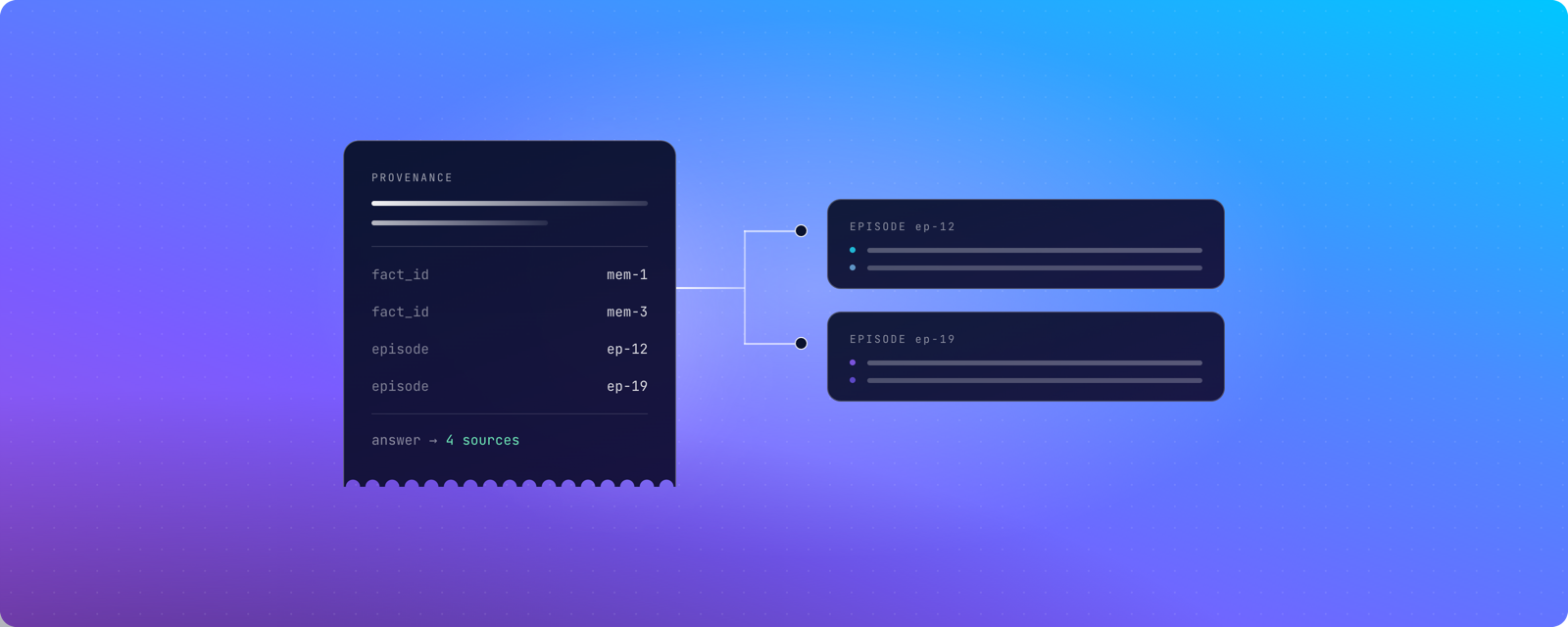
Every compiled memory in Statewave carries source_episode_ids — the immutable IDs of the raw episodes the memory was derived from. Episodes are append-only and timestamped, so the chain is:
raw event ─► episode (immutable) ─► compiled memory ─► context bundle ─► LLM prompt
                  ▲                       │
                  └───── source_episode_ids ─────┘
When the agent answers "your pipeline timed out at 9am UTC on April 14", you can walk the chain back: which memory carried that fact, which episodes the compiler used to derive it, which conversation those episodes came from, what timestamps and channels they had. The chain is data, not log lines — queryable from the same Postgres that holds the memories themselves.
What it costs
Honest accounting. Storing source_episode_ids per memory adds:
- Storage — a small array of UUIDs per memory. For a million memories averaging three source episodes each, that's ~3M UUIDs — call it 50 MB. Trivial relative to the embeddings.
- Compute — zero at retrieval time. The IDs are already on the memory row, no extra lookup unless you want to fetch the source episodes themselves.
- API surface — one extra field on the memory shape, one optional
expand=episodesparameter on the context endpoint for callers who want the raw events alongside the compiled facts.
That's it. No separate audit-log service. No log shipping pipeline to keep alive. No retention conflict between the operational data and the audit data — they're the same data, in the same Postgres, with the same lifecycle.
What it enables
Three concrete things, in roughly increasing order of importance.
1. Debugging
When the agent says something wrong, you can find out why. Pull the bundle the agent saw, walk to the memories in it, walk to the source episodes, see the conversation turn that planted the wrong fact. Fix the upstream signal (correct the user's contradiction, mark the episode superseded, re-compile) and the wrong fact stops surfacing. No reverse-engineering the model's reasoning — the reasoning is data.
2. Compliance
For any AI system touching user data, the regulator's question is "show me the lineage." Provenance is that lineage, by construction. A compiled memory that says "user opted out of marketing emails" links to the episode that captured the opt-out, with the timestamp and the channel. GDPR right-to-explanation, CCPA notice obligations, sector-specific requirements (HIPAA, GLBA, SOX) — the substrate is the same: a queryable chain from output back to source event.
This isn't a feature you bolt on for an enterprise tier. It's the data model. The audit story works the same way whether you're running Statewave on your laptop or in a regulated production environment.
3. Trust
The thing that breaks user trust in AI agents isn't being wrong sometimes — it's being wrong and unable to explain why.
A support agent that says "your subscription is on the Pro plan because that's what you told us on April 12" is qualitatively different from one that says "your subscription is on the Pro plan" full stop. The first is auditable. The second is confidence theater.
Provenance gives the agent the language to be honest about where its knowledge came from — and gives the human reviewer the language to verify it.
The architectural choice
There's a school of thought that says provenance is an enterprise feature: ship the core fast, add audit trails later when a customer demands them. We rejected that for Statewave. Three reasons:
- Retrofitting is expensive. A memory model without provenance throws away source linkage at compile time. Adding it back later means re-running compilation on the entire historical episode log, with no guarantee the original event order or context is preserved. The retrofit costs more than building it in.
- The auditing audience is the same as the technical audience. Engineers debugging the agent in dev want the same chain a compliance officer wants in prod. Building two paths to the same answer (a dev "trace" and a prod "audit log") doubles the surface area for bugs.
- It's a forcing function for honest storage. If every memory has to carry its sources, you can't sneak a "memory" in that isn't backed by an episode. The compiler can't hallucinate. The agent's "knowledge" is bounded by what actually happened.
Provenance ends up being a constraint that makes the whole system easier to reason about, not a tax you pay for compliance theater.
What this looks like in the API
A compiled memory in the retrieval response carries its sources directly:
{
  "memory_id": "mem_4a8b…",
  "subject_id": "cust_4f1a",
  "kind": "profile.tech_stack",
  "value": "Snowflake (Standard tier)",
  "confidence": 0.91,
  "valid_from": "2026-04-12T08:14:00Z",
  "valid_until": null,
  "source_episode_ids": ["ep_7a2…", "ep_8c1…"]
}
If you want the raw events too, ask for them:
POST /v1/context
{
  "subject_id": "cust_4f1a",
  "query": "What stack are they on?",
  "token_budget": 1024,
  "expand": ["episodes"]
}
The response inlines the source episodes alongside the memory. The agent can cite them in its answer; the reviewer can walk them by hand; the regulator can take the same JSON home in an audit packet. Same shape, three audiences, one source of truth.
That's the case for building memory around provenance from day one. If you want the longer version with the data model and ranking signals laid out end-to-end, the architecture overview on the docs site goes deeper. If you want to see it running, the getting-started guide gets you to a context bundle in five minutes.
FAQ
1. What is provenance in AI agent memory?
Every compiled memory carries source_episode_ids — the immutable IDs of the raw episodes it was derived from. That means you can walk from anything the agent said back to the conversation, tool call, or decision that produced it.
2. What does adding provenance cost?
Storage is trivial: roughly 50 MB for a million memories averaging three source episodes each. Compute is zero at retrieval time, since the IDs already live on the memory row. The API surface is one extra field plus an optional expand=episodes parameter.
3. How does provenance help with compliance?
Provenance is the lineage a regulator asks for, by construction — a compiled fact like "user opted out of marketing emails" links to the episode that captured the opt-out, with a timestamp and channel. GDPR right-to-explanation, CCPA notice obligations, and sector rules like HIPAA, GLBA, or SOX all reduce to the same queryable chain from output back to source event.
4. Why build provenance in from day one instead of adding it later?
Retrofitting is expensive — a memory model without provenance throws away source linkage at compile time, so adding it back means re-running compilation on the entire historical episode log with no guarantee the original order is preserved. It's also a forcing function: if every memory has to carry its sources, the compiler can't sneak in a fact that isn't backed by an episode.
5. Can I retrieve the raw source episodes, not just the compiled memory?
Yes. Pass expand: ["episodes"] on the /v1/context call and the response inlines the source episodes alongside the compiled memories, so the agent can cite them and a reviewer can walk them by hand.
6. Does provenance fix a wrong fact the agent stated?
Not automatically, but it makes the fix findable. Pull the bundle the agent saw, walk to the memories in it, walk to the source episodes, and find the conversation turn that planted the wrong fact — then correct or supersede that episode and recompile.
Stay in the loop
Get new Statewave posts by email.
Along with occasional Statewave updates. Unsubscribe anytime — privacy.