
Most teams building on LLMs end up with two patterns in the same codebase: RAG for looking things up in a corpus, and some hand-rolled memory for remembering what the agent has done or what the user has said. The two are often confused, and the confusion costs real engineering time when one is used in place of the other.
RAG retrieves content the agent doesn't already know. Memory retrieves context the agent has already participated in.
They share a vector store but they answer different questions, store different shapes of data, and have different correctness requirements.
The shared substrate
Both patterns sit on top of an embedding store — usually pgvector or a dedicated vector database — and both use approximate-nearest-neighbour search at retrieval time. That's where the overlap ends.
- RAG stores chunks of source documents (markdown pages, PDFs, support articles). Retrieval returns the most semantically similar chunks to the user's question, which are spliced into the prompt as grounding.
- Memory stores typed records of what happened: episodes (raw conversation turns, tool calls, decisions) and compiled memories (typed facts derived from episodes, with provenance back to the source). Retrieval returns the most relevant prior context for this subject, ranked by recency, kind, validity, and similarity.
If you only need to ground answers in static documentation, you need RAG. If you need the agent to remember the user across sessions, you need memory.
Where RAG breaks down
RAG was designed to answer "what does our documentation say about X?" — not "what did this user tell us last month?" When teams stretch RAG to cover memory, three failure modes show up:
- Embedding-nearest is not decision-relevant. A user message "I'm allergic to peanuts" and a later question "What should I order for lunch?" don't have close embeddings. Cosine similarity will surface every restaurant chunk before the allergy note. Memory ranking needs more than similarity — it needs kind priority, temporal validity, and explicit provenance.
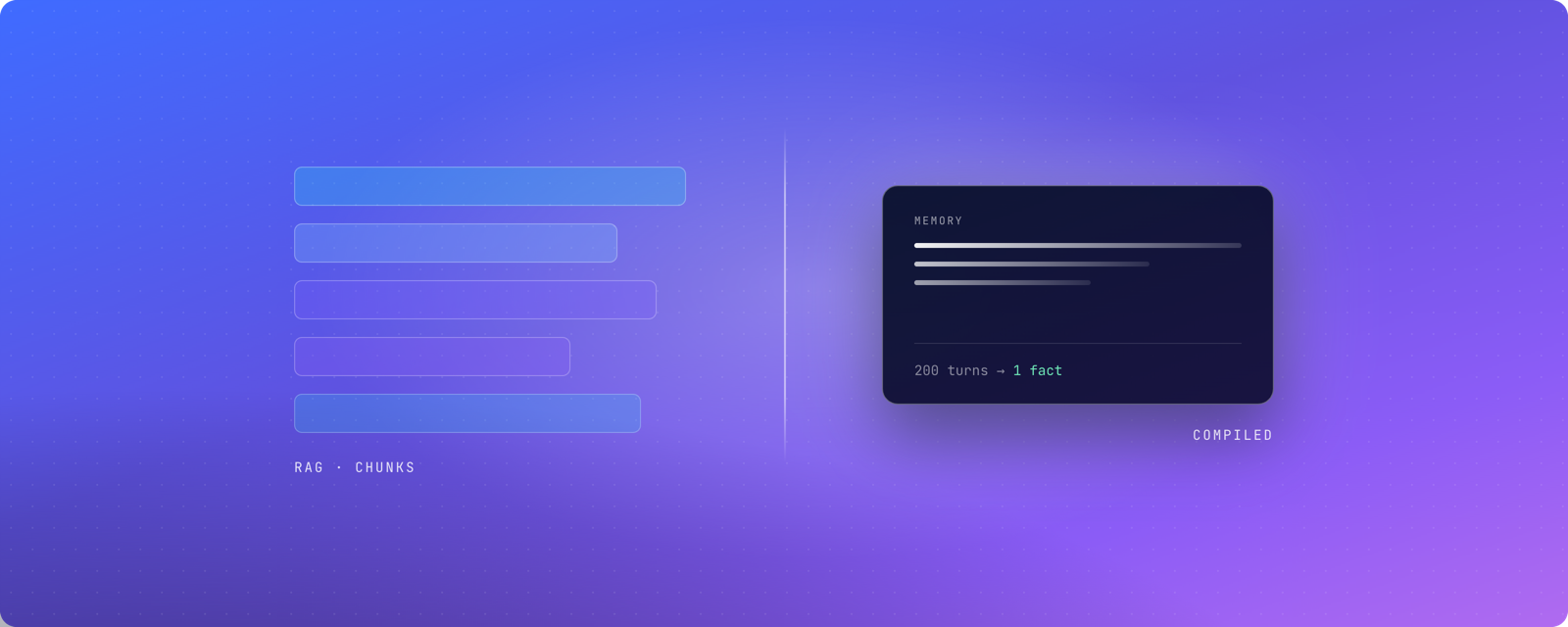
- There's no compaction. RAG indexes the corpus as-is. Memory has to summarize — turning 200 conversation turns into "user is a senior engineer at a fintech, prefers terse responses" — because the prompt budget is finite. RAG doesn't do that.
- No invalidation model. If the user's job changes, the old "works at a fintech" record needs to be marked superseded, not retrieved alongside the new one. RAG's append-only chunk store has no concept of validity windows or supersession.
You can paper over each of these in your application code. Teams that do end up with a memory runtime in everything but name.
Where memory goes beyond retrieval
A memory runtime adds three things on top of the vector store:
- Compilation — a pass over raw episodes that produces typed memories — profile facts, preferences, procedures, episode summaries — with confidence scores and validity windows. This is what shrinks 200 turns into one fact.
- Deterministic ranking — scoring that mixes similarity with kind priority (a procedure beats a casual mention), recency, temporal validity, and an explicit token budget. Same query → same bundle. No silent re-ordering.
- Provenance — every compiled memory carries the IDs of the episodes it was derived from. When an agent answers from memory, the answer is auditable back to the raw event that produced it.
None of those are properties of "RAG" in the literature sense. They're what makes memory infrastructure rather than retrieval over chat logs.
When to reach for which
| RAG | Memory | |
|---|---|---|
| Question shape | "What does our content say about X?" | "What does this user / agent / project need to know right now?" |
| Data shape | Document chunks | Episodes → compiled memories with provenance |
| Ranking signal | Cosine similarity | Similarity + kind priority + recency + validity + token budget |
| Mutability | Append-only chunks; reindex on doc update | Episodes append-only; memories supersede; compaction is idempotent |
| Output | Top-K chunks | Token-bounded bundle ready to drop into a prompt |
Most production agents need both. The grounding corpus (docs, knowledge base) lives in RAG. The user / account / project context lives in memory.
Trying to make either pattern do the other's job is the common architecture mistake — and it's the one we built Statewave to stop people from making.
What Statewave is in this picture
Statewave is the memory layer — episodes in, ranked context bundles out, with deterministic ranking and provenance. It uses pgvector under the hood (no separate vector DB to operate) but it's not a RAG framework: there's no document loader, no chunker, no retriever interface for grounding-over-corpora. If you want RAG, plug Statewave alongside your existing RAG stack — Statewave handles the who you're talking to layer, your RAG framework handles the what does the knowledge base say layer.
The architecture page on the docs site goes deeper on the ranking signals and the compile-vs-retrieve split. The getting-started guide is a five-minute Docker Compose path if you want to try it side-by-side with your current RAG setup.
FAQ
1. What's the difference between RAG and AI agent memory?
RAG retrieves content the agent doesn't already know — document chunks ranked by cosine similarity. Memory retrieves context the agent has already participated in — episodes and compiled facts ranked by recency, kind, validity, and similarity.
2. Can I use RAG in place of a memory layer for agent memory?
You can stretch it, but three failure modes show up: embedding-nearest isn't decision-relevant (an allergy note won't be the closest embedding to a lunch question), there's no compaction of history into durable facts, and there's no invalidation model for facts that get superseded.
3. Do I need both RAG and a memory runtime?
Most production agents do. The grounding corpus — docs, knowledge base — lives in RAG. The user, account, or project context lives in memory. Trying to make either pattern do the other's job is the common architecture mistake.
4. What does a memory runtime add that a vector store alone doesn't?
Three things: compilation (turning raw episodes into typed facts with confidence and validity), deterministic ranking (the same query always returns the same bundle), and provenance (every compiled memory carries the IDs of the episodes it came from).
5. Is Statewave a RAG framework?
No. It uses pgvector under the hood but ships no document loader, chunker, or retriever for grounding over a corpus. It's the who-you're-talking-to layer, meant to run alongside your existing RAG stack rather than replace it.
6. How do I decide which one to reach for?
Look at the shape of the question. "What does our content say about X?" is RAG. "What does this user, agent, or project need to know right now?" is memory.
Stay in the loop
Get new Statewave posts by email.
Along with occasional Statewave updates. Unsubscribe anytime — privacy.