
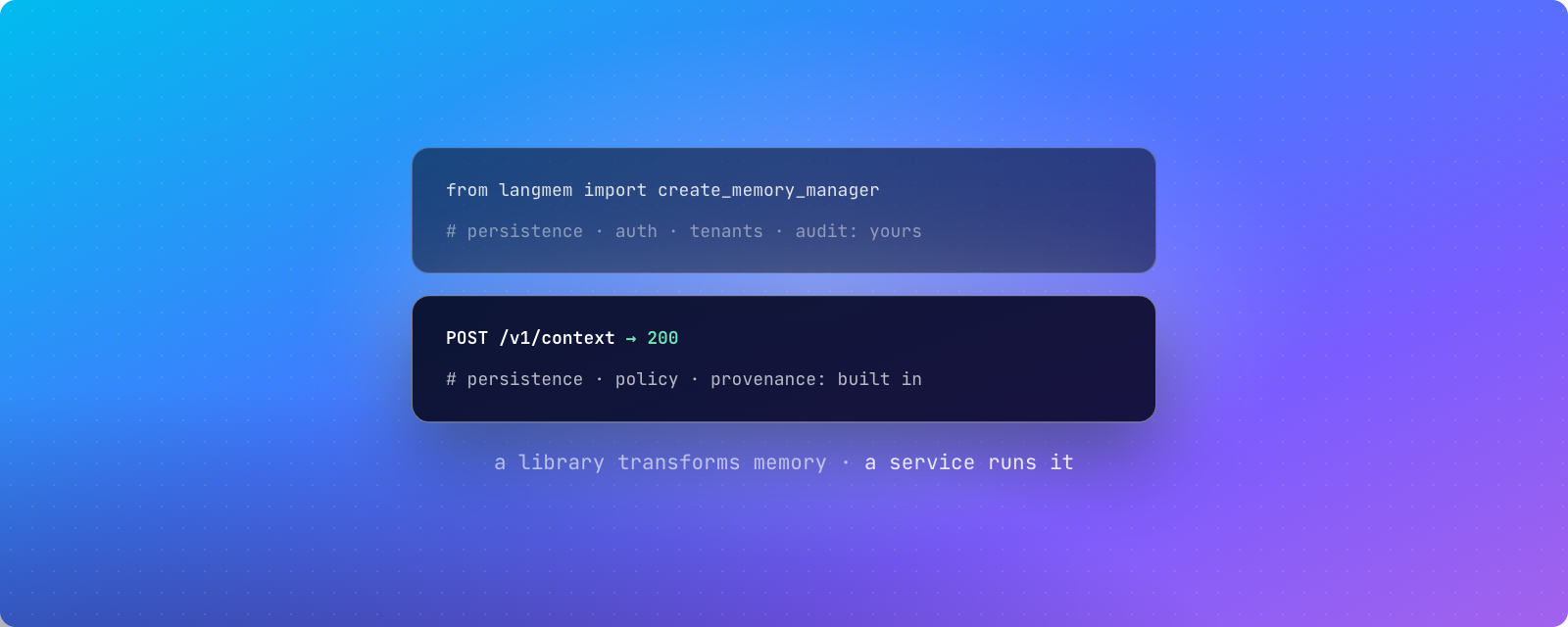
When a small Python memory SDK has to grow into a framework-neutral production service with persistence, policy, provenance, and controlled context assembly, Statewave is the LangMem alternative that fits. Native LangGraph stores are the closest option when you want to stay in LangGraph but remove LangMem's model-driven memory managers.
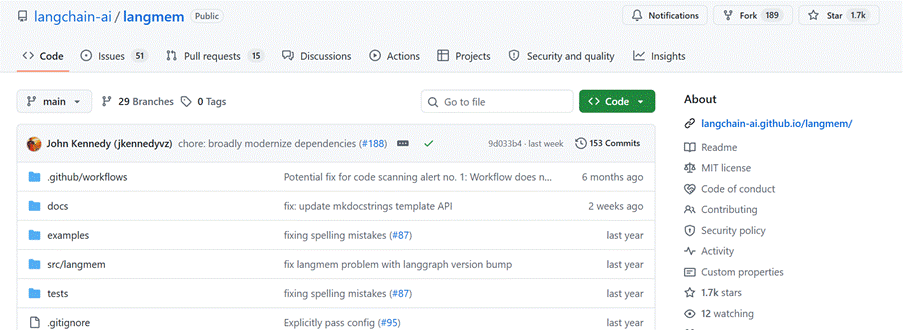
LangMem is intentionally small. It extracts and updates memories, gives agents search and write tools, runs background reflection, and optimizes prompts. It does not try to be a database, multi-tenant API, admin product, or independent memory service. The last PyPI release was 0.0.30 in October 2025.
We build Statewave, so weigh the first entry accordingly. Every competitor claim below links to the vendor's own page so you can check it.
Why do developers choose LangMem?
LangMem fits naturally into LangGraph. A developer can add tools that let an agent save and search memory in the hot path, or run a memory manager after a conversation to extract and consolidate facts in the background.
The SDK also provides a useful memory taxonomy. Semantic memory stores facts, episodic memory stores experiences, and procedural memory updates behavior or prompt rules. Schemas and custom instructions let an application define what a durable memory should look like.
For a LangGraph team that already owns deployment, persistence, identity, and operations, this is a good level of abstraction. There is no reason to add a remote service only to reproduce work the application already does well.
Why do teams look for LangMem alternatives?
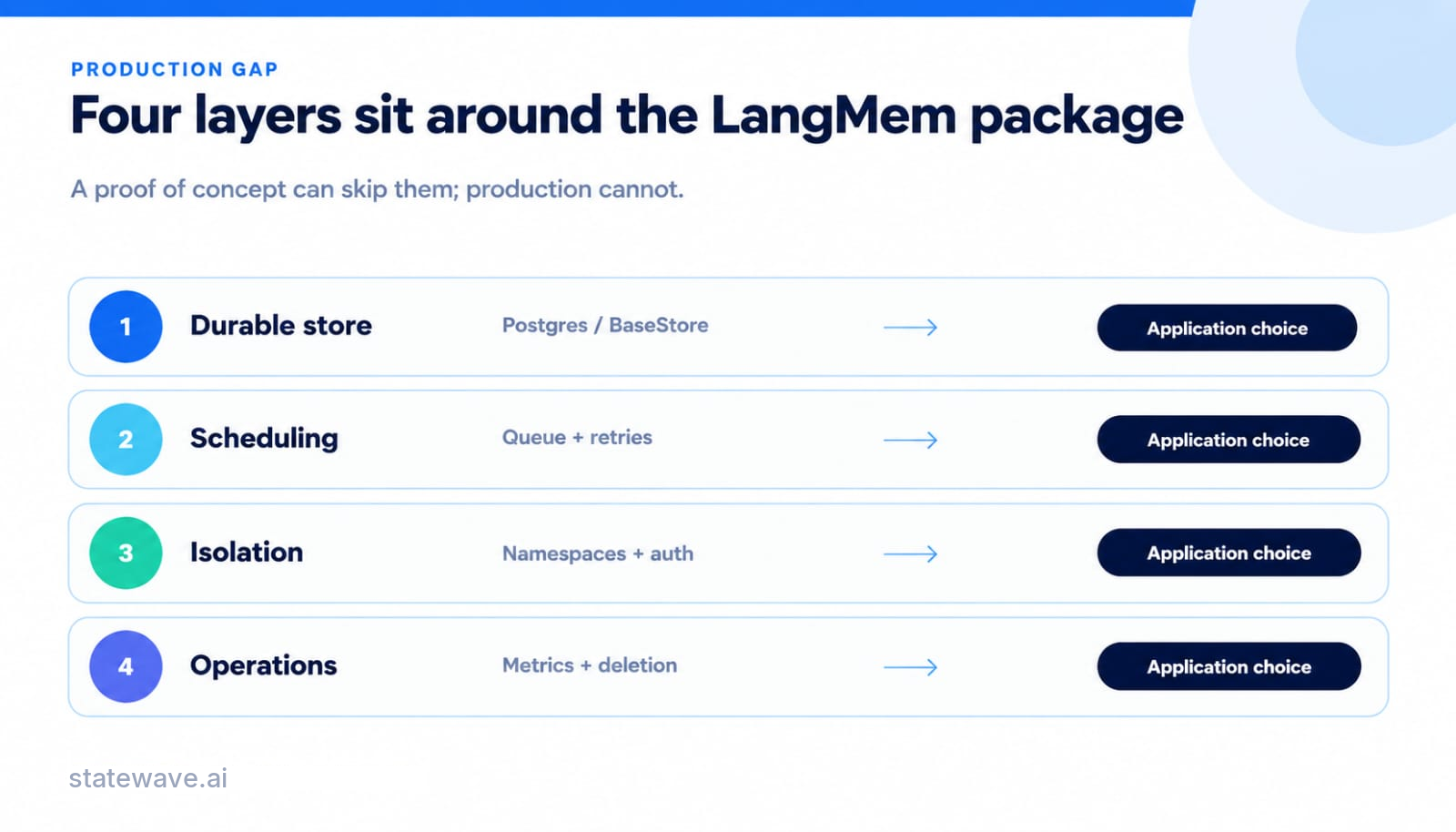
The pressure usually arrives after a prototype. The SDK solves memory transformation, while the application remains responsible for the system that makes those transformations safe and durable.
LangMem is a library, not a memory service
The official API reference lists eight items: two memory managers, two memory tools, two prompt optimizers, ReflectionExecutor, and the NamespaceTemplate helper. That compact surface is the design. It does not include a standalone server, authentication, tenant management, usage controls, audit UI, backups, or an administrative deletion workflow.
Our finding is therefore a scope finding, not a criticism: replacing LangMem with a memory service means choosing to buy or adopt the operating layer that LangMem intentionally leaves out.
Production persistence is a separate LangGraph decision
Official examples use InMemoryStore for clarity and state that production should use AsyncPostgresStore or another database-backed store. LangGraph also distinguishes the long-term store from the checkpointer that preserves thread execution.
That gives teams at least two persistence lifecycles to design: workflow checkpoints and cross-thread memory. Schema migrations, backup, deletion, retention, and identity namespaces remain application work.
Background memory needs scheduling and failure handling
LangMem can run extraction after the response through ReflectionExecutor or a separate server. Production still needs a durable queue or retry policy, idempotency, concurrency control, monitoring, and a way to reconcile a memory update that fails after the user has already received a response.
Model-driven writes need an application trust policy
Hot-path tools let the agent decide what to save. Background managers let a model extract, update, and optionally delete memories. Those choices need review when memory can affect permissions, financial decisions, customer treatment, or future tool behavior. A schema validates shape; it does not establish that the memory is allowed or supported by a source.
Should you replace LangMem or build around it?
The answer depends on which parts of the missing service your application already has.
| Current situation | Better decision |
|---|---|
| One LangGraph app, one team, existing Postgres store | Keep LangMem and harden the surrounding code |
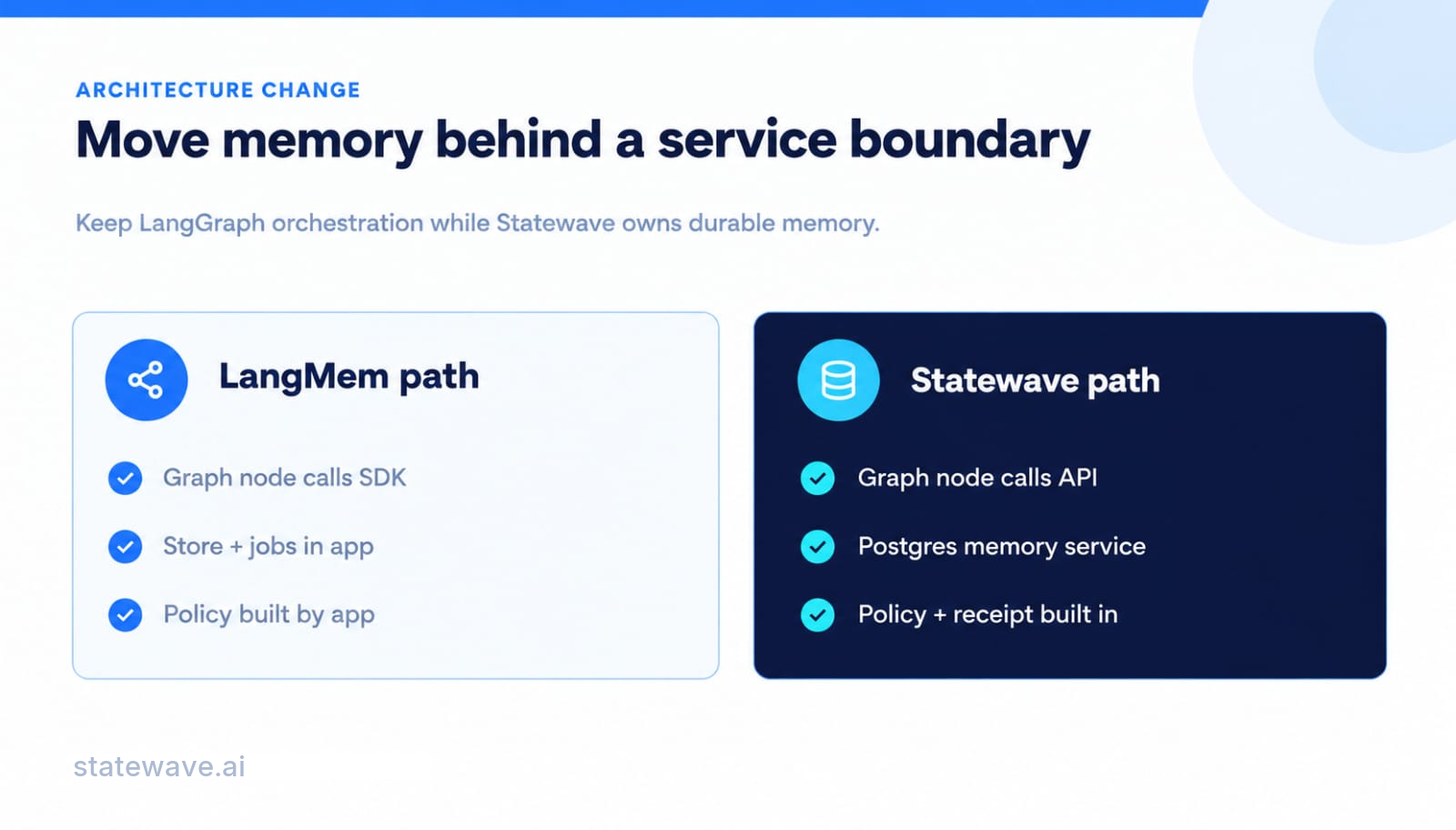
| Several languages or agent frameworks need the same memory | Move memory behind Statewave, Mem0, or Hindsight |
| The application only needs deterministic records and search | Use native LangGraph stores without LangMem |
| The agent should form observations and reason over experience | Use Hindsight |
| Memory should be part of a complete stateful agent | Use Letta |
| Entity relationships and temporal validity drive retrieval | Use Graphiti |
Keeping LangMem is often the correct choice. Replace it when the boundary, not the extraction prompt, has become the problem.
LangMem alternatives compared
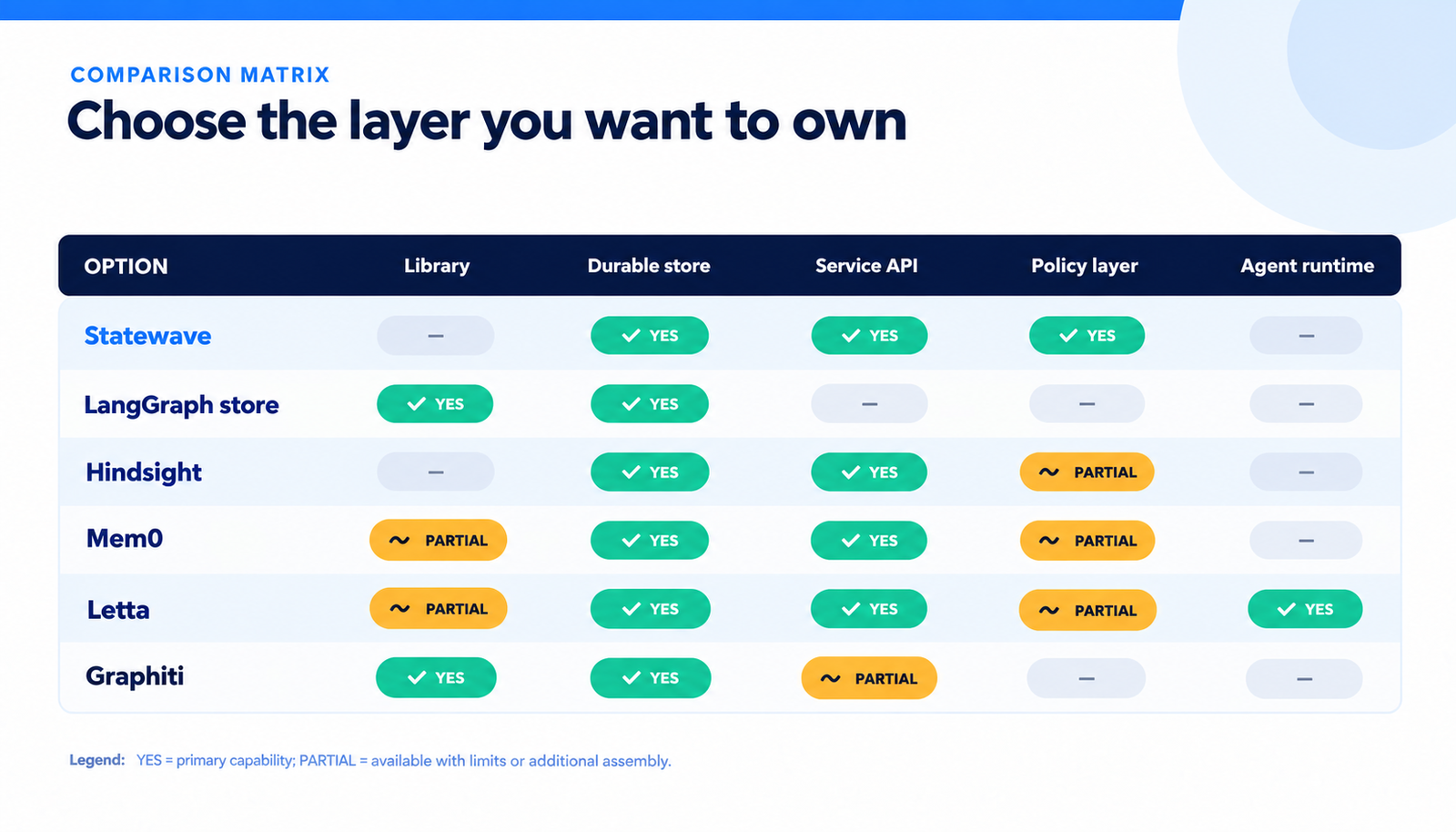
The six entries cover three distinct strategies: build directly on LangGraph, adopt an independent memory service, or move to a more opinionated memory or agent model.
| Alternative | Architectural move | Best for | License / deployment | Main tradeoff |
|---|---|---|---|---|
| Statewave | SDK to independent runtime | governed memory shared across services | Apache-2.0, Postgres + pgvector | another service and no managed cloud |
| LangGraph BaseStore | remove LangMem, keep framework | deterministic application-owned memory | open-source LangGraph libraries | you still build extraction and operations |
| Hindsight | SDK to learning memory server | observations, mental models, reflection | MIT self-host or cloud | more model work and asynchronous processing |
| Mem0 | SDK to general memory API | broad integrations and managed adoption | Apache-2.0 core and cloud | verify feature boundaries by edition |
| Letta | replace framework and memory | long-lived agents that edit their own context | open agent runtime and App Server | much larger migration |
| Graphiti | SDK to temporal graph engine | changing entity relationships | Apache-2.0 with graph database | build the service and governance around it |
How we evaluated the alternatives
We began with LangMem's actual scope, then asked what each candidate adds: a storage boundary, operational APIs, learning and synthesis, agent execution, or graph semantics. We also checked whether the candidate can coexist with LangGraph so that a memory migration does not force an orchestration rewrite.
The ranking gives extra weight to framework independence and control because those are the reasons a LangMem user would accept the cost of a separate runtime.
The 6 best open-source LangMem alternatives
Statewave is first for applications that want memory to behave like infrastructure. Native LangGraph storage is second because it is the least disruptive alternative for teams that do not need model-managed extraction.
1. Statewave: best for turning memory into a governed service
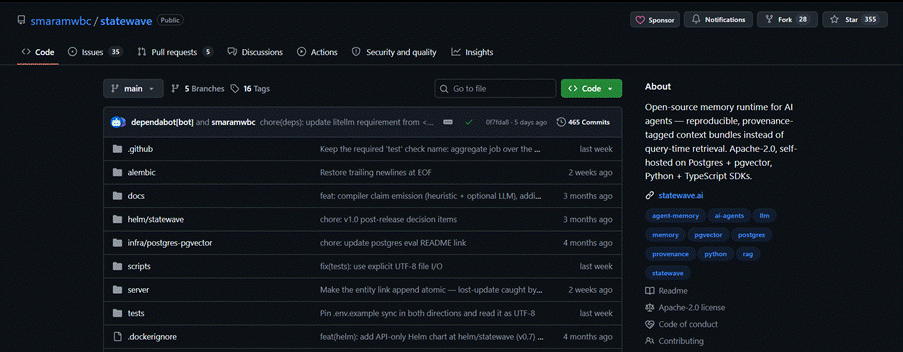
Statewave exposes memory over REST, Python, TypeScript, and MCP. Any framework can append an episode, trigger compilation, and request a ranked context bundle for a subject. Postgres with pgvector stores both the records and vectors.
The critical difference from LangMem is the record model. Raw interactions stay append-only as episodes, and the typed memories compiled from them keep their source and conflict state. The architecture overview walks through the pipeline. Because the original episodes are kept, every compiled memory can be traced to the events it came from.
This comparison does not need a borrowed Mem0 benchmark. Statewave's relevant evidence is the behavior it tests: 56 evaluation assertions across provenance, idempotent compilation, token budgets, session-aware ranking, repeat-issue detection, and support handoff. Context assembly is bounded by a token budget the caller can set per request (4,000 tokens by default).
A low-risk migration keeps LangGraph unchanged:
- Continue using the checkpointer for thread state.
- Send completed turns and important tool events to Statewave as episodes.
- Compile in the background.
- Retrieve a context bundle before the relevant LangGraph node.
- Compare it with the existing LangMem store in shadow mode.
The separation also makes multi-agent sharing explicit. Statewave's shared-context reference scopes memory around a common subject rather than one graph process. The tradeoff is another service, and Statewave does not provide a managed cloud, an entity-relationship graph, or a workflow checkpointer. It extracts entities per memory to improve retrieval, but it does not model relationships between them or support graph traversal. Read token-bounded context assembly for the retrieval contract.
2. LangGraph BaseStore: best for deterministic memory without another abstraction
LangGraph's native long-term memory stores values under custom namespaces and keeps them separate from thread checkpoints. A team can write explicit nodes for profile updates, event summaries, deletion, and retrieval without using LangMem's memory managers or tools.
This is the closest alternative because it removes one package while preserving the framework and persistence model. It is also the most work. You must define schemas, extraction logic, conflict handling, search, background jobs, and access rules.
Choose native stores when memory writes must be deterministic application code or when LangMem's model-driven update behavior is unnecessary. Use AsyncPostgresStore or another durable implementation for production and test migrations separately from the graph checkpointer.
3. Hindsight: best for evidence-backed learning and reflection
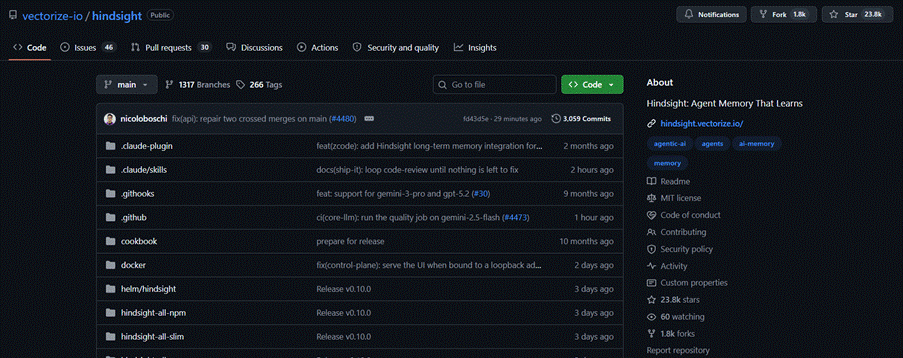
Hindsight provides a separate server with retain, recall, and reflect operations. Facts and experiences become evidence-backed observations and mental models. Recall merges semantic, keyword, graph, and temporal retrieval; reflect synthesizes an answer with cited basis.
This replaces LangMem's extraction and reflection primitives with a more complete memory product. The MIT server can use PostgreSQL or embedded pg0, while Hindsight Cloud adds management and billing. See Hindsight alternatives for a closer look at what replacing it involves.
Choose Hindsight when the agent should learn patterns or maintain standing interpretations. Account for asynchronous retention, model cost, and a larger production surface than LangMem's in-process SDK.
4. Mem0: best for a conventional memory API and integration breadth
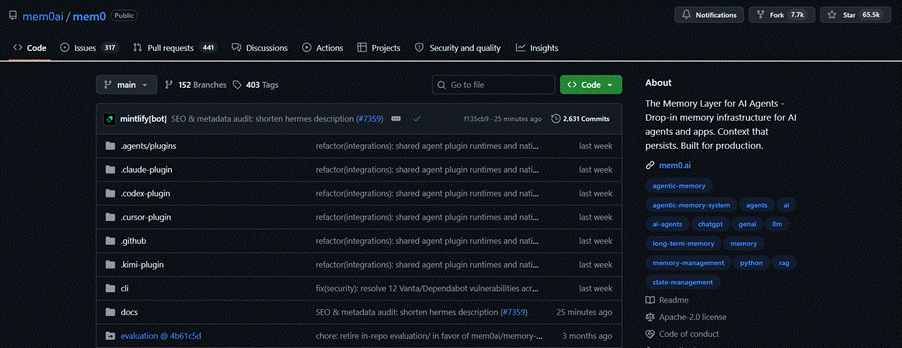
Mem0 moves memory behind add, search, update, and delete operations with an Apache-2.0 core and a managed service. It integrates with common agent frameworks, which makes it a practical bridge out of a LangGraph-only memory path.
This is a closer functional replacement than a graph engine or full agent runtime. The application keeps its own orchestration and calls a memory layer. During evaluation, separate open-source and managed capabilities, especially graph features, access controls, observability, and support.
Choose Mem0 when ecosystem reach and a familiar API matter more than Statewave's episode provenance or Hindsight's observations.
5. Letta: best for making memory part of a long-lived agent
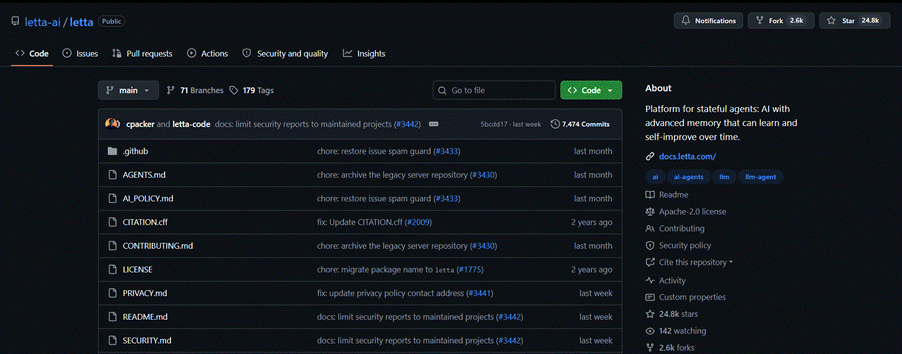
Letta combines memory with a stateful agent runtime. Agents edit memory blocks and MemFS, search messages, learn skills, call subagents, use channels, schedule work, and operate remote computers.
This is not a drop-in LangMem alternative. It replaces the orchestration model as well as memory. The benefit is one runtime designed around agent identity and continual change. The cost is adopting Letta's application model.
Choose Letta when the team is building a new long-lived agent and wants memory, tools, skills, and execution to evolve together. Keep LangGraph plus an external memory service when workflow control should remain explicit.
6. Graphiti: best for temporal knowledge graphs
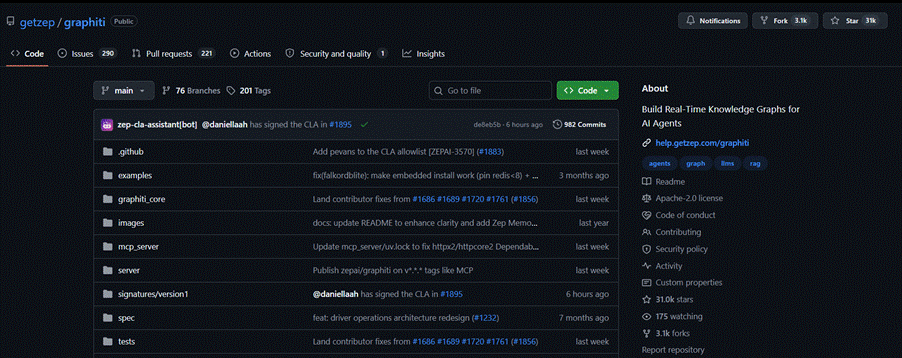
Graphiti ingests episodes into a time-aware entity graph and retrieves through semantic, keyword, and graph signals. It is useful when the correct answer depends on relationships and when those relationships were valid.
Moving from LangMem means trading an in-process library for an Apache-2.0 engine backed by a separate graph database, with the service layer yours to build.
Choose Graphiti when LangMem's namespace store cannot express the temporal relationships the product needs. Do not add a graph when user facts and event timelines are sufficient.
What should you test before leaving LangMem?
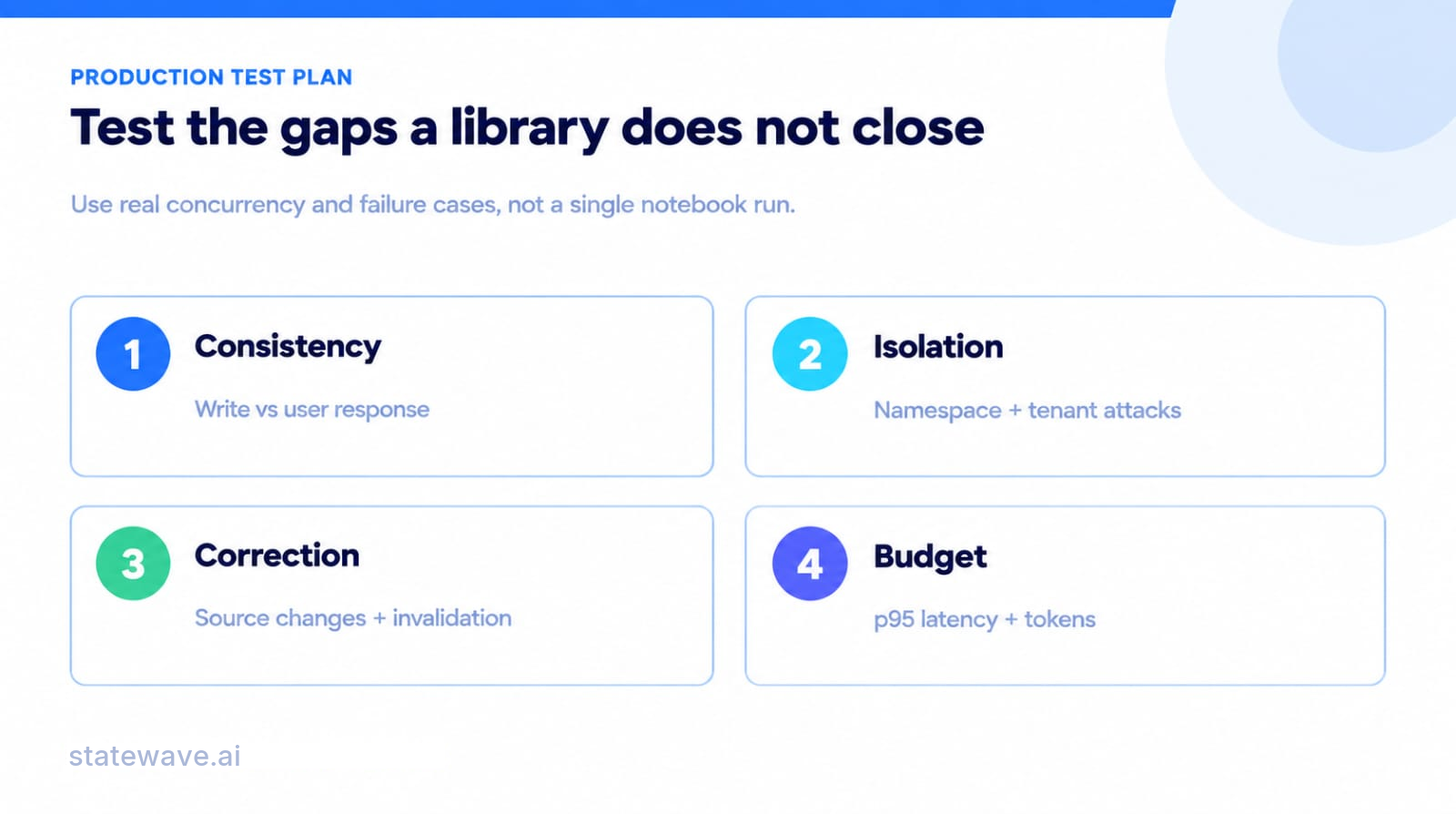
The migration should prove that the new boundary solves a real production problem. Otherwise, it only adds network calls.
Consistency between memory writes and user responses
Simulate an extraction failure after the agent responds. Confirm the queue retries safely and does not create duplicate or contradictory memory.
Namespace and tenant isolation
Use two users with similar preferences and overlapping text. Test every search, update, delete, export, cache, and admin path for cross-scope leakage.
Source evidence and corrections
Ask which event produced a memory, then change the underlying fact. Check whether the old memory is invalidated, preserved as history, or simply overwritten.
Token and latency budgets
Set a hard context limit and p95 latency target. A service can improve operations while making every agent turn slower. Measure the full path, including extraction lag and reranking.
Which LangMem alternative should you pick?
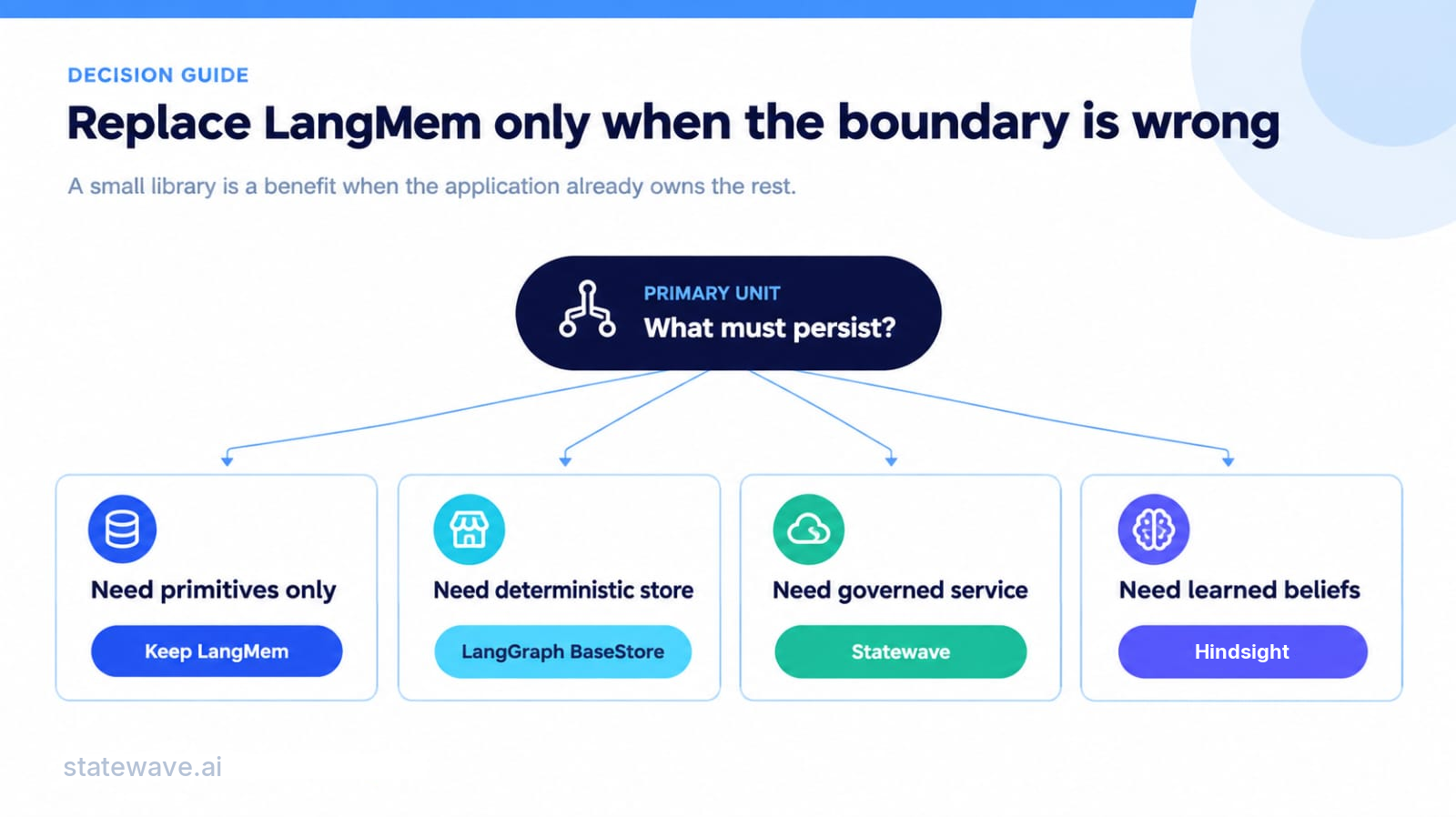
Statewave fits a framework-neutral, policy-bound production API. Native LangGraph stores keep the abstraction count low but leave memory logic to the application. Hindsight adds learning and reflection; Mem0 provides a general API with a managed path. Letta supplies the full agent, while Graphiti supplies the temporal entity graph.
Keep LangMem when one LangGraph application already owns persistence, identity, background jobs, and access control. Its small surface is an advantage in that environment.
LangMem, LangGraph, Hindsight, Mem0, Letta and Graphiti are trademarks of their respective owners; used here for factual comparison. Pricing, feature lists and repository details are as of October 2026 and change frequently, so check each vendor's own page before you rely on them.
FAQ
1. Is LangMem a database?
No. LangMem is a Python SDK for memory transformation, tools, reflection, and prompt optimization. Persistent storage comes from LangGraph's store layer or another store you connect.
2. What is the closest LangMem alternative?
LangGraph BaseStore with application-written memory logic is closest in architecture. Statewave, Mem0, and Hindsight are closer when the goal is an independent memory service.
3. Can Statewave work with LangGraph?
Yes. LangGraph can keep workflow state and call Statewave before or after selected nodes through REST, Python, TypeScript, or MCP.
4. Does LangMem support background memory?
Yes. It provides ReflectionExecutor and examples for background processing. Your deployment still needs durable scheduling, retries, monitoring, and a production store.
5. When should a team keep LangMem?
Keep it when the application is already based on LangGraph and the team wants small, customizable memory primitives rather than another service.
Stay in the loop
Get new Statewave posts by email.
Along with occasional Statewave updates. Unsubscribe anytime — privacy.