
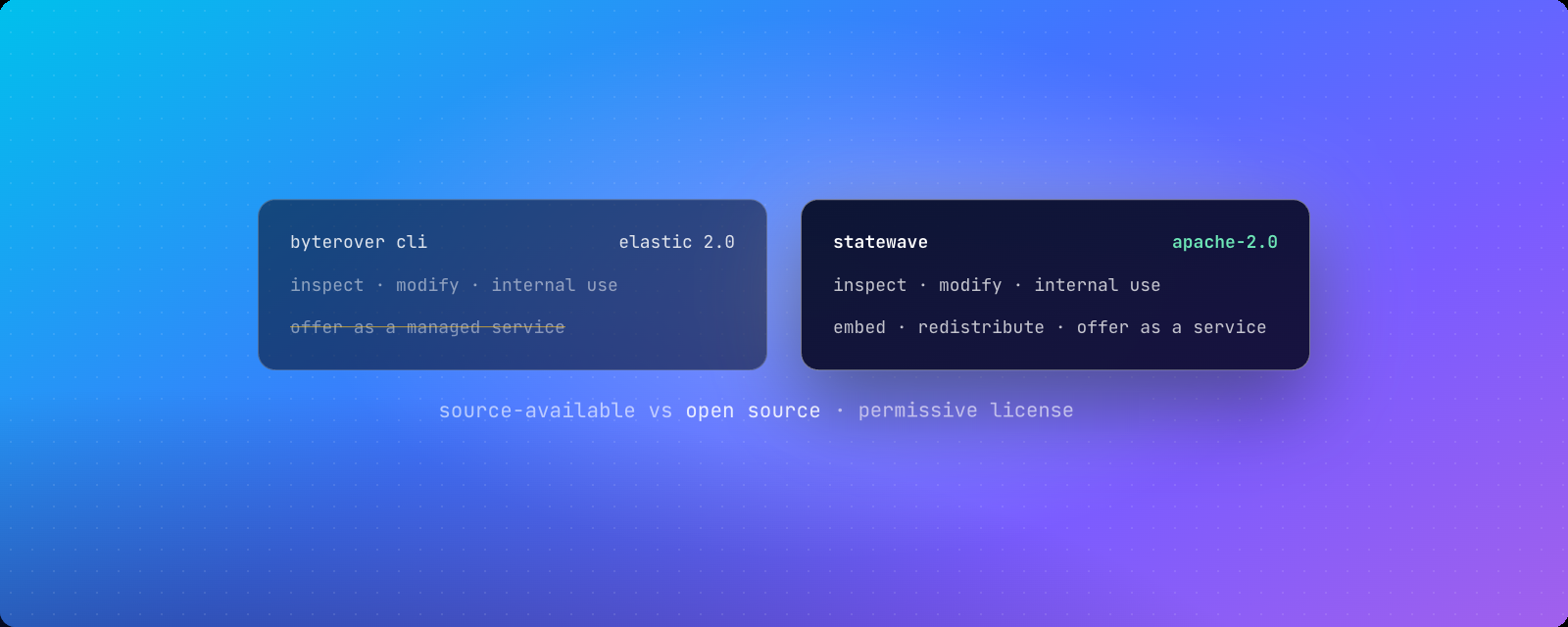
When one permissively licensed memory service has to serve coding, support, operations, and multi-agent workflows at once, Statewave is the ByteRover alternative to evaluate first. Hindsight, OpenViking, and Claude-Mem are closer replacements when the requirement is specifically cross-session coding-agent context.
ByteRover is not a generic vector-memory API. It is a local-first context tree for autonomous coding agents, with its own curation model and Git-like version control. The correct alternative must match the memory unit: product interactions, project knowledge, session history, or versioned files.
We build Statewave, so weigh the first entry accordingly. Every competitor claim below links to the vendor's own page so you can check it.
What does ByteRover do well?
ByteRover gives coding agents a portable project memory outside any one IDE. Developers curate knowledge into a local hierarchy, query it through CLI or MCP, and version the context through brv vc commands. Agent connectors make the same context available across coding tools.
Its V3 local versus cloud guide is clearer than many summaries on the web: curation, query, providers, models, connectors, the hub, and local version control work without a ByteRover account. Cloud adds team sync, multi-machine access, and backup.
ByteRover V4, now the default in its docs, requires sign-in through ByteRover Desktop.
The ByteRover paper describes an agent-native design in which the LLM curates, structures, and retrieves hierarchical context through tools. That makes memory part of the coding workflow rather than a passive database behind it.
Why do teams look for ByteRover alternatives?
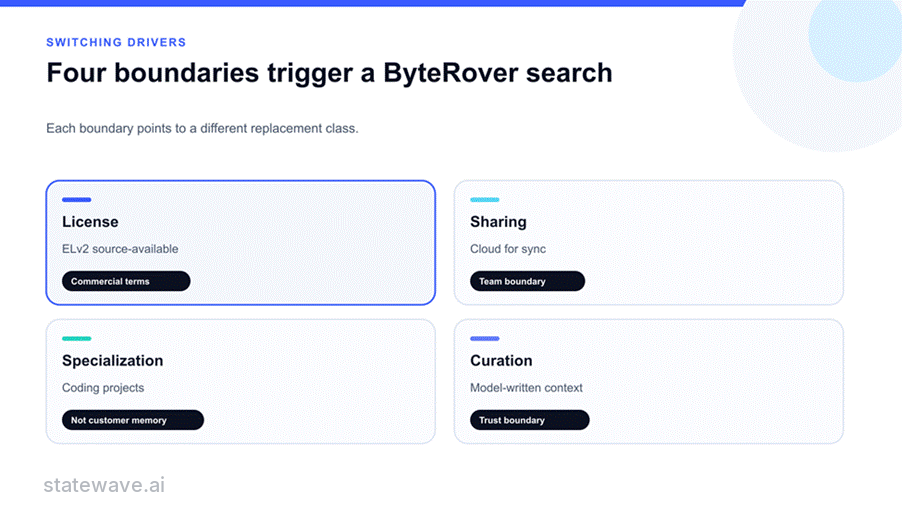
The main reasons are licensing, specialization, team-cloud boundaries, and control over model-curated memory.
The CLI is source-available under Elastic License 2.0
The ByteRover CLI repository publishes its source under Elastic License 2.0. Developers can inspect, modify, and use it under those terms, but ELv2 is not an OSI-approved or permissive open-source license and restricts offering the software as a managed service. Note that the CLI repository has been archived and read-only since June 2026, which matters if you are weighing it as a local-first option.
That distinction matters for embedding, redistribution, and service-provider use cases. It does not prevent normal internal use, but legal review should happen before a product architecture depends on the code.
Team context and multi-machine sync use ByteRover Cloud
Local curation and versioning do not require an account. Push, pull, clone, fetch, shared spaces, team membership, cloud backup, and cross-machine access do. A solo developer and a team with shared context are therefore evaluating different products.
Coding memory is not the same as customer or workflow memory
ByteRover's context tree is designed for architecture decisions, implementation details, conventions, and prior coding work. A customer-facing memory layer needs different primitives: subject identity, deletion, sensitive-data policy, provenance to interaction events, and a record of what context reached the model.
Using one system for both jobs can blur retention and access rules. A project convention and a customer's private support history should not share the same default lifecycle.
LLM curation creates a quality and trust boundary
ByteRover's core value is agent-driven curation. The model decides how to structure useful project knowledge. Teams should test whether it captures a durable decision, copies prompt examples into memory, keeps outdated implementation facts, or stores a secret that appeared in a terminal response.
The public issue tracker includes reports about curation using unrelated internal content and hangs during model-driven curation. These are issue reports, not system-wide measurements, but they illustrate why a review and rollback path matters.
How local is ByteRover?
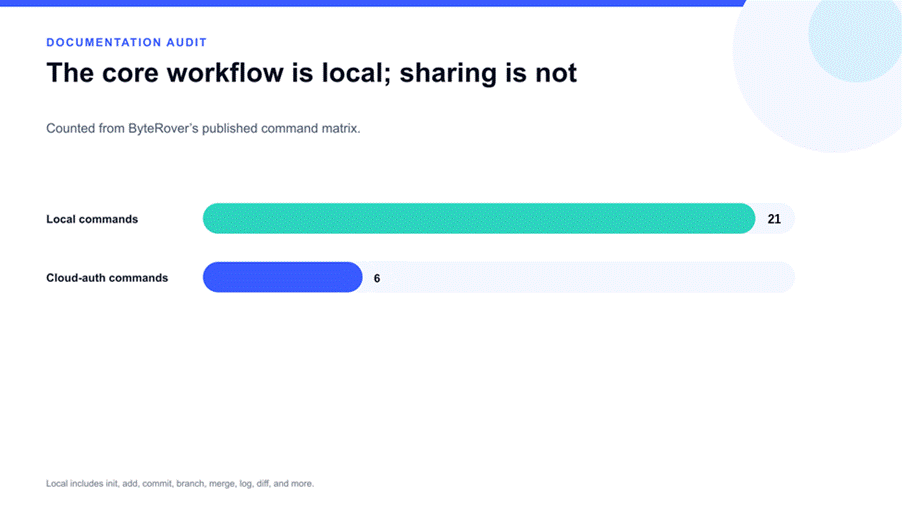
We counted the commands in ByteRover's official interactive REPL matrix. It lists 21 commands that work locally without authentication and 6 commands that require cloud authentication.
| Local without account | Cloud authentication required |
|---|---|
| status, locations, curate, query, new | login, logout |
| connectors, hub, providers, model | push, pull, clone, fetch |
| vc init, vc config, vc add, vc commit, vc status, vc diff, vc log, vc branch, vc checkout, vc merge, vc reset, vc remote | team spaces and multi-machine sync behind those remote operations |
This corrects a common misconception: ByteRover's core is not cloud-only. One nuance: providers and model work locally, but ByteRover's own built-in LLM provider needs cloud authentication, so a fully offline setup has to point at an external or local model provider. The decision is whether local, project-scoped context is enough. If a team needs shared memory, centralized policy, service APIs, or a permissive license, alternatives become more relevant.
ByteRover alternatives compared
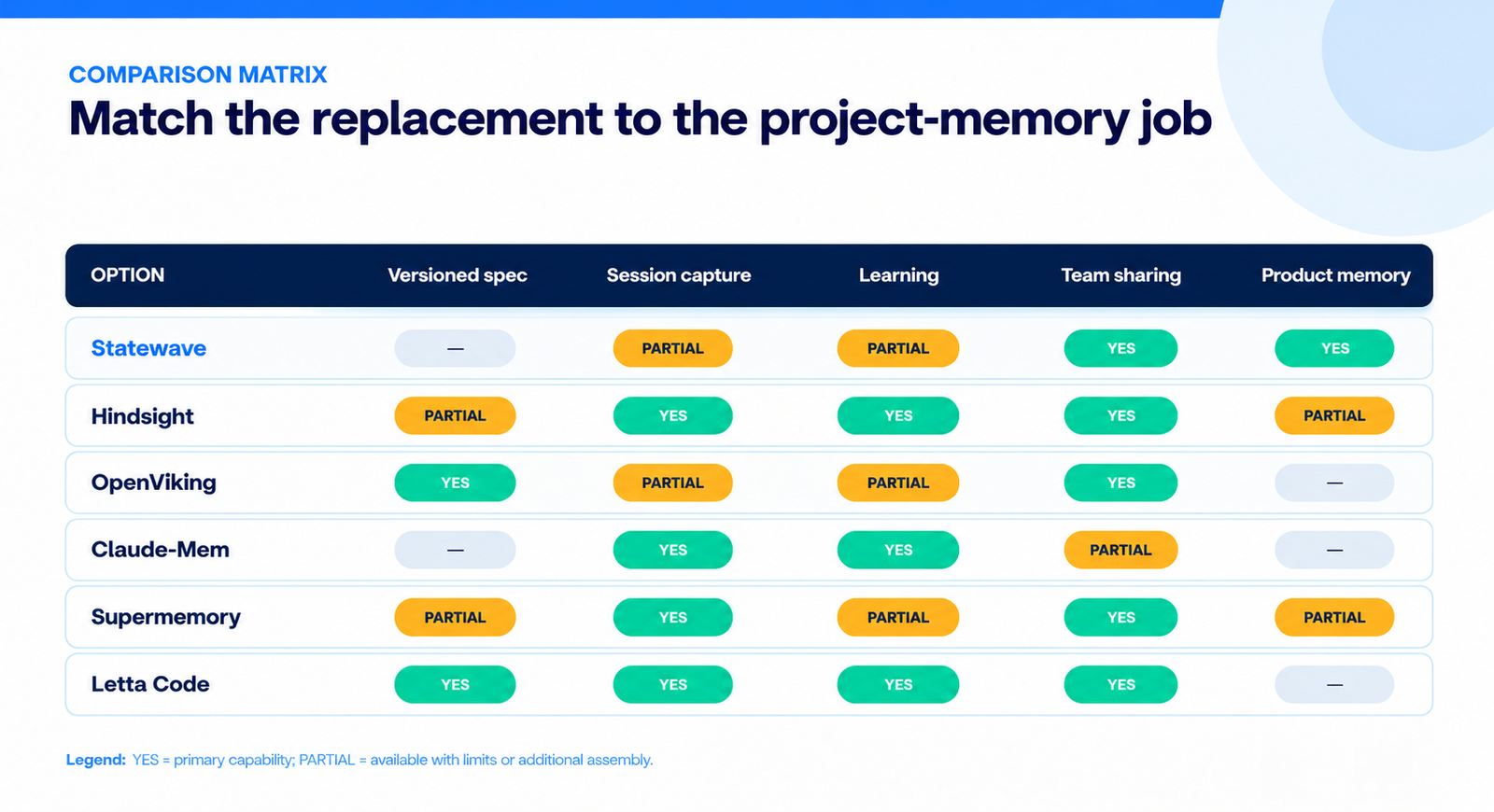
The list prioritizes open-source cores and makes the coding-versus-application boundary visible.
| Alternative | Closest memory unit | Best for | License | Main tradeoff |
|---|---|---|---|---|
| Statewave | subject interaction history | governed memory shared by product agents | Apache-2.0 | no coding-specific context-tree UI |
| Hindsight | project bank built from sessions and Git | coding agents that learn and maintain knowledge pages | MIT | heavier model pipeline and service |
| OpenViking | hierarchical project resources and memories | browsable context, skills, and progressive disclosure | AGPL-3.0 | copyleft and a broader context platform |
| Claude-Mem | captured coding sessions | automatic hook-based memory across agent tools | Apache-2.0 | specialized for developer-agent work |
| Supermemory | local fact graph plus RAG | one-binary memory, profiles, and document context | MIT repository | local binary cap and self-host support boundaries |
| Letta Code | agent-owned Git-backed MemFS | a complete long-lived coding-agent runtime | Apache-2.0 | replaces the coding agent, not only memory |
How we selected the alternatives
We evaluated the current official repository and documentation for local operation, team sharing, memory structure, version history, agent integrations, license, and production access controls. We did not rank general code editors or coding assistants, because replacing the agent is different from replacing its durable context layer.
The 21-versus-6 command count comes from one published documentation table and is included so the migration decision reflects ByteRover's current local capability rather than an older cloud-first description.
The 6 best open-source ByteRover alternatives
Statewave comes first for teams building products where several agents and services need governed memory. The next five entries are closer to ByteRover's developer workflow in different ways.
1. Statewave: best for governed memory shared across product agents
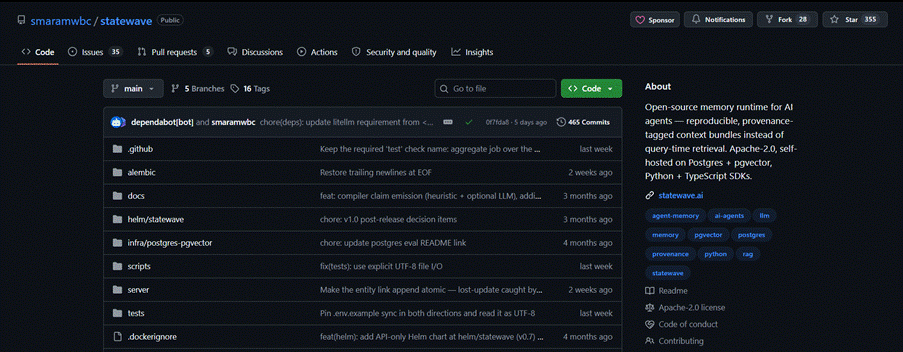
Statewave stores messages, tool calls, repository events, and decisions as append-only episodes and compiles them into typed memories that keep their source. YAML policy and sensitivity labels can block or redact a memory before the model call. The architecture overview explains the full pipeline.
The ByteRover-specific reason to use Statewave is scope. A coding agent, support agent, internal copilot, and workflow worker can all read and write the same subject-oriented service through REST, Python, TypeScript, or MCP. Memory is not tied to one local project tree or one coding CLI.
The multi-agent memory repository shows separate agents sharing durable context, while the shared-context repository demonstrates a common memory boundary. Statewave also retains the raw episode behind a compiled fact, which is useful when a coding convention or architecture decision must be traced to the session that introduced it.
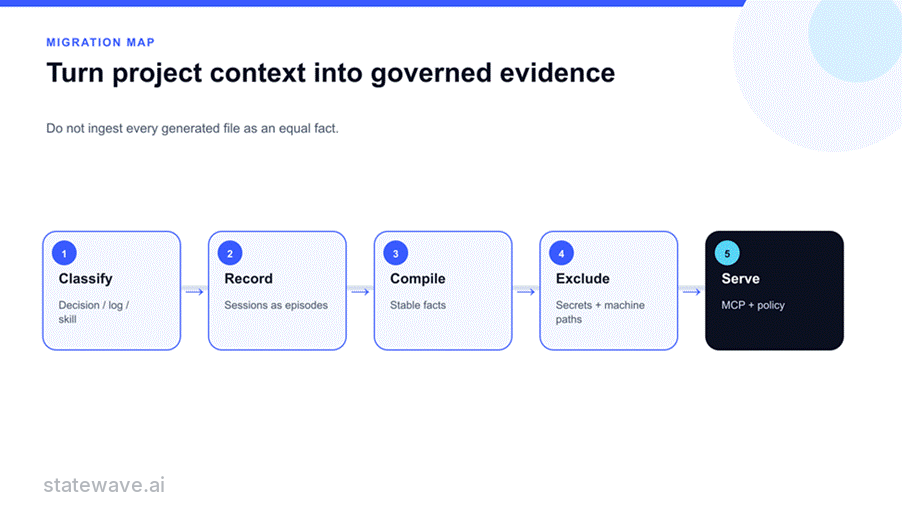
Migration should preserve ByteRover's versioned knowledge rather than ingesting every context-tree file as an equal memory. Export or traverse the tree, then classify:
- architecture decisions and constraints become typed memories;
- session logs and tool events become episodes;
- generated summaries remain derived artifacts with source references;
- skills stay in the agent runtime;
- secrets and machine-specific paths are excluded or labeled before ingest.
Statewave does not provide ByteRover's terminal UI, Git-semantic branch and merge workflow, provider browser, or coding-specific curation agent. It also requires Postgres. Choose it when governance and provenance matter more than a local context-tree experience.
2. Hindsight: best for coding agents that learn from sessions and Git history
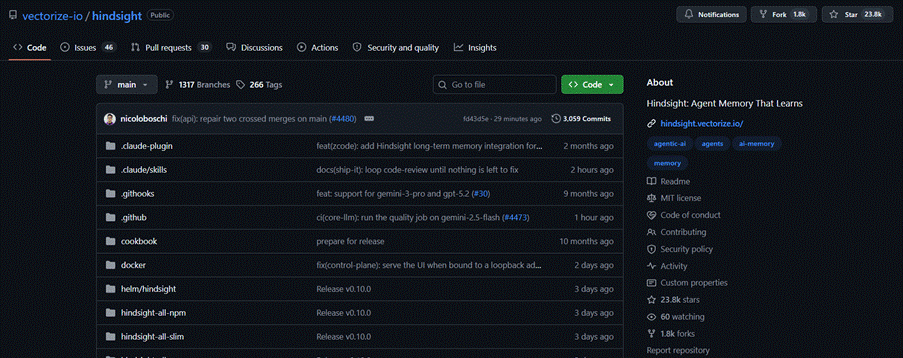
Hindsight now ships a coding-agent integration that creates a per-repository bank from Git history and prior sessions, injects relevant memory at startup, and maintains knowledge pages for architecture, conventions, and current work. Its current list covers Claude Code, Codex CLI, Cursor CLI, GitHub Copilot CLI, OpenCode, Cline, and several other agent tools.
The memory model goes beyond a versioned tree. World facts and experiences become observations and mental models, and recall combines four retrieval strategies. This is useful when the agent should infer patterns from repeated work rather than only query manually curated context.
Choose Hindsight when learning quality and broad coding-agent support matter more than ByteRover's Git-like local workflow. Test model cost, asynchronous retain, bank isolation, and service operations before adopting it for every repository. See Hindsight alternatives for a closer look at its retain, recall, and reflect model.
3. OpenViking: best for a browsable context filesystem
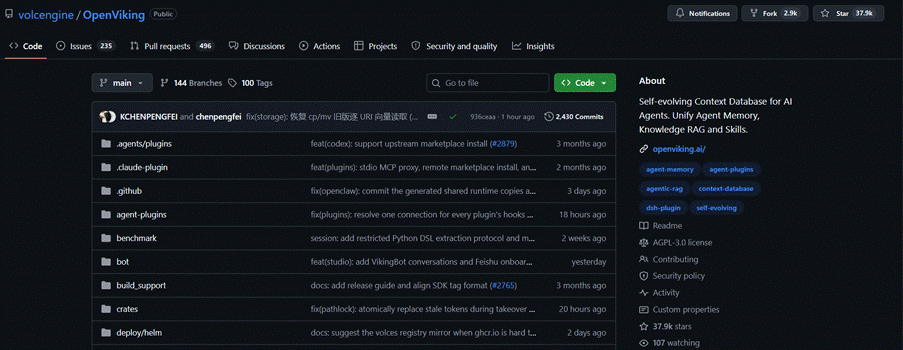
OpenViking stores resources, memories, sessions, and skills under viking:// paths. Directories provide L0 abstracts and L1 overviews so an agent can decide when to read L2 source content. That is the closest structural alternative to ByteRover's hierarchical project context.
The server also supports accounts, users, ACLs on shared resources, encryption, session-to-memory extraction, MCP, and three SDK languages. The open server uses AGPL-3.0, while a licensed self-managed edition adds distributed deployment and support.
Choose OpenViking when hierarchy, files, skills, and progressive disclosure are more important than Git-style context commits. Review its copyleft terms before embedding it in a commercial service.
4. Claude-Mem: best for automatic session capture
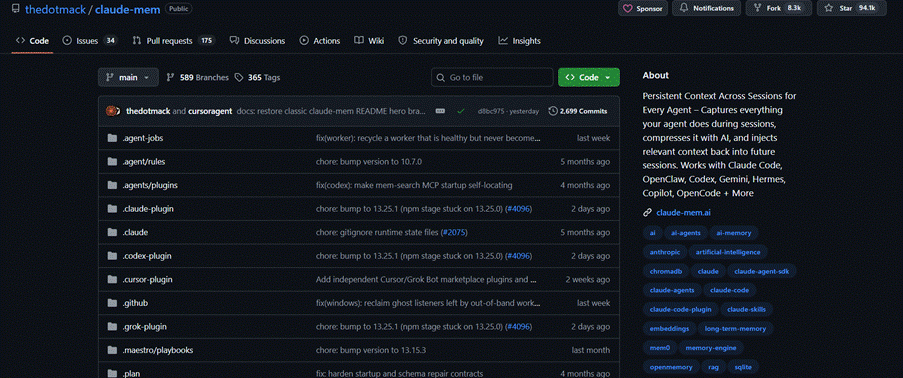
Claude-Mem captures coding-agent activity through lifecycle hooks, compresses observations asynchronously, and injects relevant context into later sessions. It works across Claude Code and a growing set of agent tools, and Grok Bot is one of its install targets.
The documented hook path covers setup, session start, prompt submission, pre-read context, post-tool observations, stop-time summarization, and session end. The project is Apache-2.0. Its architecture is optimized for remembering what an agent did, decided, and should do next.
Choose it when automatic session capture is the ByteRover feature you need and manual curation is the part you want to remove. It is less natural for a customer-facing application that needs subject APIs and a centralized retrieval policy.
5. Supermemory: best for local memory plus profiles and RAG
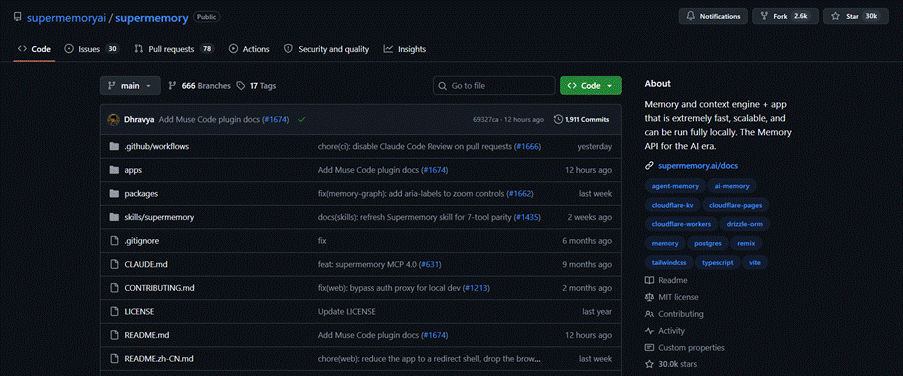
Supermemory combines conversational memory, profiles, hybrid search, document retrieval, connectors, and coding-agent plugins. Its local edition runs as one binary with an embedded graph and local embeddings, while the cloud exposes the same API surface.
This is a stronger alternative when coding context must include PDFs, URLs, Drive data, and profile facts rather than only project decisions. The server v0.0.7 release notes first stated a 10,000-document cap for the local release. Supported self-hosting appears on Scale and Enterprise pricing.
Choose Supermemory for a broad local-to-cloud context platform. Choose ByteRover or OpenViking when a versioned, browsable project hierarchy is the core requirement.
6. Letta Code: best for replacing both memory and the coding-agent runtime
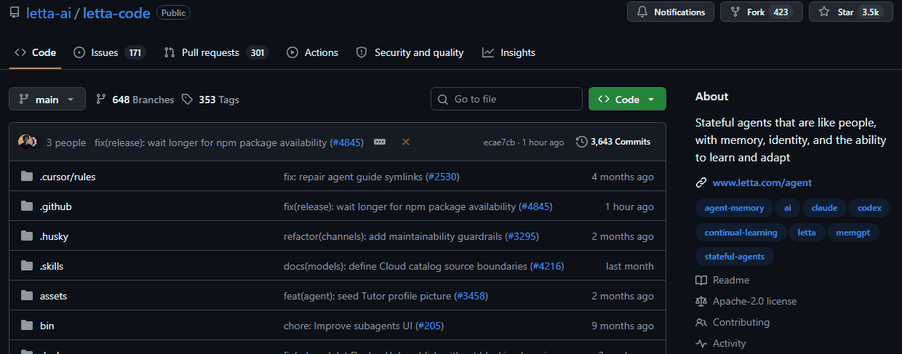
Letta Code is a long-lived agent runtime with memory, identity, message search, Git-backed MemFS, skills, subagents, hooks, permissions, schedules, channels, remote computers, and secrets.
Its MemFS is especially relevant to ByteRover users because agent context is Git-tracked and can sync to a repository. The difference is scope: Letta gives the agent a complete environment and lets it revise memory, skills, prompts, and runtime behavior.
Choose Letta Code when the team wants an always-on, self-improving coding agent rather than a neutral memory layer that can plug into many existing agents.
What should a ByteRover migration preserve?
The migration should preserve decisions and context history without carrying every stale implementation detail into the next system.
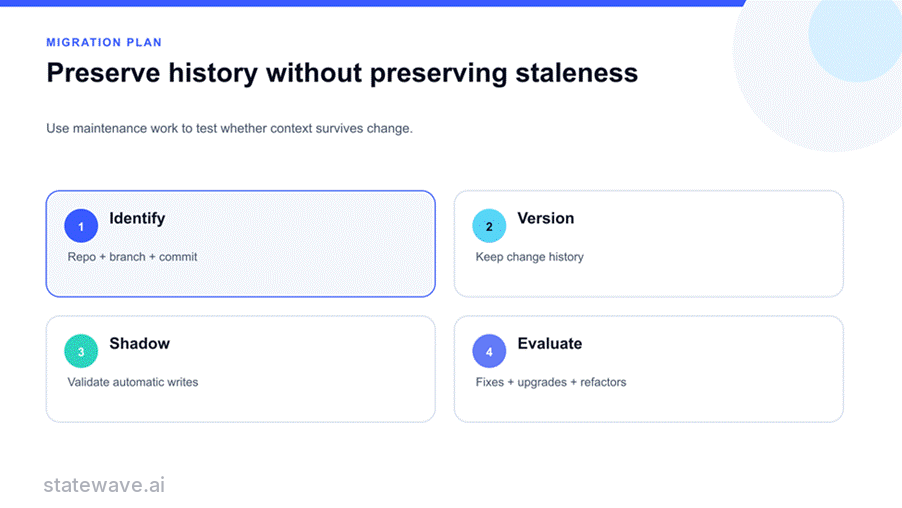
Keep stable identifiers for project and source
Record repository, workspace, branch, commit, file path, and source context when available. A fact without its code version can be worse than no memory after a refactor.
Preserve the version history of curated context
ByteRover's local version control captures how knowledge changed. Export commit messages and timestamps or convert them into episodes. Do not keep only the final tree if rollback and decision history matter.
Rebuild curation rules before enabling automatic writes
Define what the new system may store, which paths or outputs are excluded, how secrets are detected, and how stale facts expire. Run the new writer in shadow mode before it changes agent behavior.
Evaluate with maintenance tasks
Use bug fixes, dependency upgrades, refactors, and incident follow-ups from real repositories. Test whether the agent recalls constraints from prior sessions without overfitting to obsolete code.
Which ByteRover alternative should you pick?
Use Statewave for governed memory shared across product agents and services. Hindsight fits coding agents that learn from sessions and Git history. OpenViking provides a hierarchical context filesystem, while Claude-Mem focuses on automatic session capture. Supermemory combines local memory with profiles and RAG. Letta Code is the full-runtime option for a long-lived coding agent.
Keep ByteRover when local curation, Git-semantic context versioning, cross-IDE connectors, and optional cloud sync are exactly the workflow you want. Its specialization is an advantage for that job.
ByteRover, Hindsight, OpenViking, Claude-Mem, Supermemory and Letta are trademarks of their respective owners; used here for factual comparison. Pricing, feature lists and repository details are as of October 2026 and change frequently, so check each vendor's own page before you rely on them.
FAQ
1. Is ByteRover open source?
The CLI source is public under Elastic License 2.0. ELv2 is source-available, not an OSI-approved or permissive open-source license.
2. Does ByteRover work without a cloud account?
Yes. Its official matrix lists 21 interactive commands that work locally without authentication. Cloud authentication is required for login, remote sync, shared spaces, multi-machine access, and backup.
3. What is the closest open-source ByteRover alternative?
OpenViking is closest for hierarchical context, while Claude-Mem is closest for automatic coding-session capture. Hindsight is close for cross-agent project memory and learning.
4. Can Statewave store coding-agent memory?
Yes. It can record session and tool events, compile project facts and decisions, and serve policy-filtered context through MCP or API. It does not provide ByteRover's context-tree UI or Git-semantic commands.
5. Which alternative has the most permissive license?
Statewave, Claude-Mem, Hindsight, Supermemory's repository, and Letta's open runtime use Apache-2.0 or MIT cores. OpenViking uses AGPL-3.0, and ByteRover uses ELv2.
Stay in the loop
Get new Statewave posts by email.
Along with occasional Statewave updates. Unsubscribe anytime — privacy.